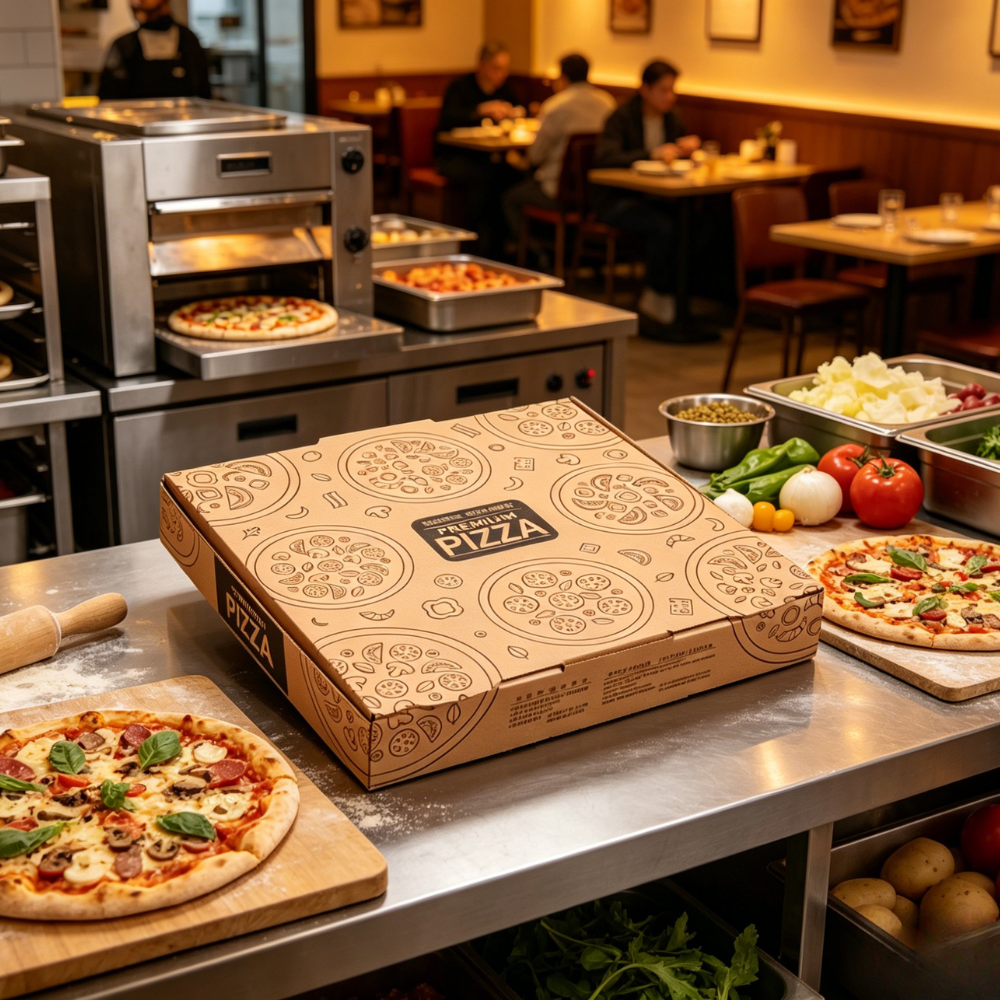
The global surge in off-premise dining has fundamentally transformed the foodservice industry. While consumers often credit seamless app interfaces and fast driver networks for this convenience, the physical foundation of the food delivery ecosystem relies heavily on packaging. The moment a pizza leaves the oven, it enters a hostile environment of fluctuating temperatures, physical vibration, and trapped moisture.
For the modern food ecosystem to function, takeaway pizza boxes must perform flawlessly. They are no longer just basic paper containers; they are engineered thermal vessels and high-impact marketing tools.
From the perspective of an experienced packaging manufacturer, the demands placed on a pizza delivery box vary significantly depending on who is using it. Restaurants need food preservation, delivery networks need operational efficiency, and packaging distributors require supply chain reliability. Here is an objective look at how sourcing the right takeaway pizza boxes supports each of these key stakeholders.
For an independent pizzeria or a national pizza franchise, the primary concern is the food itself. A chef can spend hours perfecting the hydration of their dough and sourcing premium cheeses, but if the takeaway pizza boxes fail during a 30-minute transit, the end consumer receives a soggy, lukewarm product. In the age of digital reviews, poor packaging directly damages a restaurant’s reputation.
The core challenge lies in balancing heat retention with moisture ventilation. When a 400-degree pizza goes into a box, it releases a massive amount of steam. If the box is fully sealed, the steam condensates on the lid and drips back onto the crust.
To solve this, reputable manufacturers utilize precisely die-cut corrugated pizza boxes. The structural fluting of the cardboard plays a critical role in managing this thermal dynamic.
| Corrugated Flute Type | Thickness | Insulation Quality | Stacking Strength | Best Application for Pizza |
| B-Flute | ~3.2mm | High | Excellent | Large, heavy 16" to 18" deep-dish pies |
| E-Flute | ~1.6mm | Good | Very Good | Standard 10" to 14" takeaway pizza boxes |
| F-Flute | ~0.8mm | Moderate | Good | Personal pies or single slices |
E-flute is the most common industry standard for standard pies. It provides enough insulating air pockets within the board to keep the food hot, while integrated rear ventilation holes allow just enough excess steam to escape. By investing in structurally sound corrugated pizza boxes, restaurants ensure their culinary investment arrives at the customer's dining table exactly as it left the cutting board.
The rise of third-party delivery apps and ghost kitchens has created a new type of stakeholder. These operators do not have a physical dining room; the pizza delivery box is their only physical touchpoint with the customer.
From an operational standpoint, delivery drivers often carry multiple orders simultaneously. If a restaurant uses thin, low-grade paperboard, the boxes will warp under the heat and humidity. When a driver stacks three of these flimsy boxes in a thermal bag, the bottom box collapses, crushing the cheese into the lid. High-quality takeaway pizza boxes with high Edge Crush Test (ECT) ratings prevent this, ensuring vertical stacking strength during transit.
Beyond logistics, ghost kitchens and delivery brands rely on packaging for customer acquisition. Without a neon sign on a busy street, these brands must turn their packaging into mobile billboards.
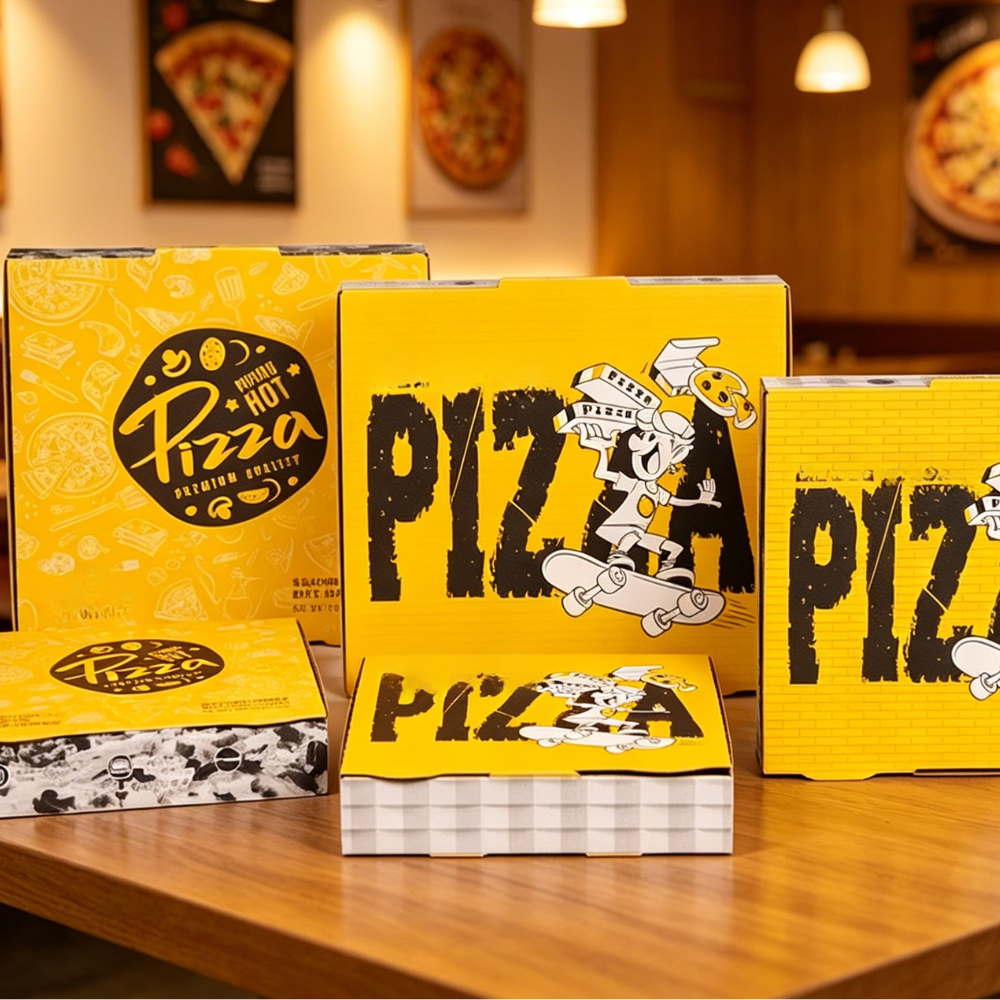
This is where custom printed pizza boxes provide a massive return on investment. Advanced flexographic printing allows brands to cover the lid and sides with vibrant graphics, reheating instructions, or digital QR codes. A well-designed QR code on custom printed pizza boxes can bypass third-party delivery fees on the next order by directing the customer straight to the brand's native app. In this way, the box actively pays for itself by reducing future customer acquisition costs.
While restaurants and delivery brands focus on the end consumer, regional packaging distributors have entirely different priorities. Distributors buy bulk pizza boxes by the container load. Their margins depend on supply chain reliability, warehouse space optimization, and regulatory compliance.
Space Optimization: Air is the enemy of profitable logistics. Shipping fully assembled boxes is financially unviable. Therefore, takeaway pizza boxes are manufactured to be shipped flat. A key indicator of supplier quality is how tightly and accurately these flat boxes are bundled and palletized. Precision die-cutting ensures that the flat boards nest perfectly, allowing a manufacturer to compress thousands of bulk pizza boxes onto a single pallet. This maximizes ocean freight container space, directly lowering the landed cost per unit for the distributor.
Regulatory Compliance: Today's packaging distributors face strict global food safety regulations. In the past, many paper mills treated packaging with PFAS (per- and polyfluoroalkyl substances) to achieve grease resistance. With sweeping bans on these "forever chemicals" across Europe and North America, distributors holding non-compliant inventory risk massive financial losses.
When sourcing takeaway pizza boxes, distributors must ensure their manufacturing partner utilizes FDA and EU ISEGA-compliant, PFAS-free barriers. A reliable supplier will provide integrated transparency, offering immediate access to ISO 22000 certifications and food-safe barrier documentation, ensuring the distributor’s inventory passes any corporate audit or customs inspection.
The journey of a pizza from a commercial oven to a residential living room is surprisingly complex. The packaging must act as an insulator, a structural support, a marketing asset, and a compliant, easily storable commodity.
Whether you are a global restaurant franchise protecting your signature crust, a ghost kitchen scaling your brand visibility, or a regional distributor managing high-volume logistics, the quality of your packaging dictates your success. By understanding the structural science and supply chain mechanics behind a premium pizza delivery box, procurement teams can move beyond viewing packaging as a sunk cost. Instead, sourcing high-quality takeaway pizza boxes becomes a strategic lever to drive customer satisfaction, streamline delivery operations, and protect long-term profitability.
Our technical team can clarify how these insights apply to your specific product line and market requirements. Reach out to discuss your needs.

 EN